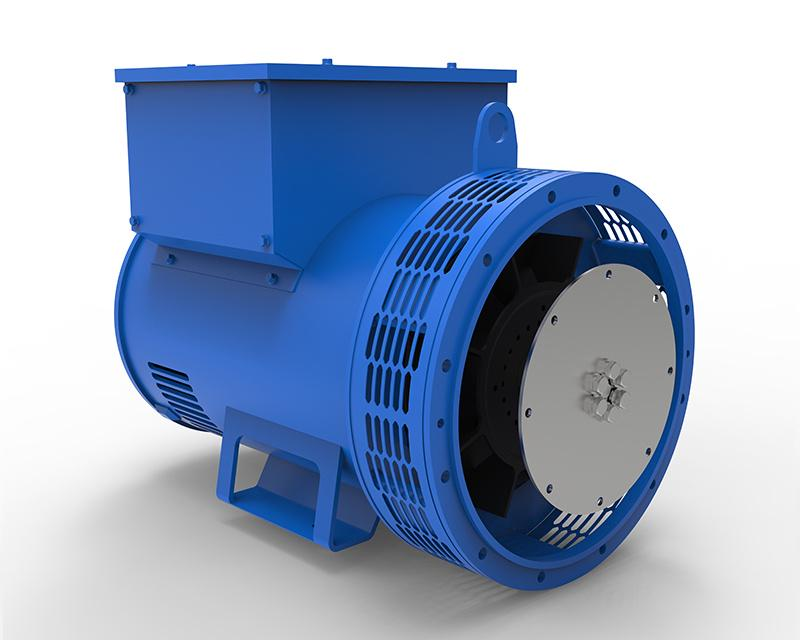
Small industrial and communications sites often operate almost entirely on single-phase equipment. Remote base stations, radar nodes, compact drilling locations, control cabinets, lighting, and communications power modules may not justify a three-phase distribution system. A dedicated single phase alternator arrangement can simplify the electrical design when the load profile is genuinely single phase.
EvoTec Power presents the EVO188 series across 25 to 54 kVA and identifies configurations that can be matched with 30 kVA or 45 kVA generator sets. The range provides a technical starting point for compact duties, but final selection must still consider voltage, frequency, poles, transient demand, environment, and maintenance access.
Using a three-phase alternator at a reduced single-phase rating may appear convenient, yet the approach can introduce uneven winding currents and poor utilization. If loads are not balanced, zero-sequence effects and local heating may reduce reliability. The designer should compare that compromise with a machine intended to supply the required single-phase output.
The correct choice depends on measured consumption rather than the site’s physical size. Modems, rectifiers, heaters, battery chargers, pumps, and intermittent tools can create distinct starting and harmonic behavior. A load schedule should include continuous power, step changes, acceptable voltage variation, future expansion, and the consequences of losing each circuit.
Representative load data collected over several operating days can distinguish steady communications demand from short environmental-control peaks, producing a more defensible rating than a single maximum observation.
Dedicated Output Avoids Three-Phase Imbalance
A single phase alternator applies its active material to the required output arrangement instead of leaving phases lightly loaded or unevenly stressed. This can produce a more compact and efficient solution for a site that has no meaningful three-phase demand, while also simplifying distribution boards, protection, metering, and cable routing.
Electrical balance matters because heating is not always visible in the total kilovolt-ampere figure. Unequal phase currents can raise conductor and winding temperatures, affect voltage quality, and complicate neutral design. A dedicated machine allows protection and regulation to be coordinated around the actual single-phase circuit instead of an improvised derating rule.
The EVO188 platform lists 400 or 480 V generator arrangements, 50 or 60 Hz operation, and choices from two to ten poles. Single-phase reconnection is identified as an option. Engineers should confirm the exact output connection, rated current, neutral treatment, protective devices, and compatibility with the prime mover before approving the set.
Compact dimensions do not eliminate transient requirements. Communications power supplies may draw nonlinear current, while pumps or cooling fans can impose motor-starting demand. The automatic voltage regulator and excitation system must maintain acceptable voltage for sensitive controls while the engine governor preserves frequency through the same event.
Neutral conductors and protective devices should be sized for the expected current and harmonic content, with termination temperature and voltage drop checked across the complete distribution route.
Matching Communications and Control Equipment
Remote communications sites commonly combine direct-current rectifiers, battery systems, climate control, lighting, and monitoring electronics. Their continuous demand may be modest, but power quality matters because repeated resets or charger faults can interrupt service. The generator assessment should cover harmonic current, grounding, neutral capacity, and the restart sequence after an outage.
At a radar or measurement node, electromagnetic compatibility and stable regulation may be more important than expansion capacity. Cable segregation, shielding, radio-interference suppression, and correct bonding should be coordinated with the equipment supplier. Monitoring interfaces can report voltage, current, frequency, alarms, and operating hours without replacing local protective functions.
The 45 kva generator also fits compact control cabinets when its voltage and frequency match the connected modules directly. Avoiding unnecessary conversion stages can reduce losses and failure points. However, battery autonomy, transfer equipment, and generator starting reliability remain part of the complete availability design.
Maintenance provisions deserve early attention at sites that technicians visit infrequently. The EVO188 series includes Class H insulation, a 2/3 winding pitch, self-excitation, and an ETC-1 AVR. Options such as a space heater, auxiliary winding, current or potential transformers, and double bearings should be justified by environment and service strategy.
Battery chargers and rectifiers should be tested in their normal operating modes because charging current, power-factor correction, and restart behavior can differ materially from simple resistive test loads.
A Compact Machine Still Needs Industrial Discipline
Shock-resistant construction and a short ventilated form can help in demanding installations, but mounting, airflow, and enclosure clearances must be preserved. Dust screens, acoustic panels, or cramped shelters should not recirculate hot discharge air. Temperature observations should be recorded alongside load and ambient conditions to reveal loss of cooling margin.
Moisture protection is equally relevant in unmanned shelters. Additional marine varnish can provide moisture-proof, mould-proof, and anti-fogging treatment, while a correctly controlled space heater can limit condensation during shutdown. These measures complement routine insulation checks; they do not excuse water ingress, blocked ventilation, or poor cable sealing.
Factory and site testing should confirm no-load voltage, regulation, waveform, protection, starting response, and the operation of transfer controls. A controlled load-bank sequence can reveal weaknesses before the system is left unattended. Documentation should include connection diagrams, settings, spare-part references, maintenance intervals, and emergency operating instructions.
For specialized small loads, EvoTec Power offers a credible combination of configuration flexibility, compact industrial construction, environmental options, and serviceable excitation features. A properly engineered single-phase machine avoids the inefficiency and thermal risk of forcing an unsuitable three-phase arrangement into a duty it was not designed to serve.
The commissioning record for a 45 kva generator should capture regulator settings, protection values, waveform observations, load steps, and baseline temperatures so later maintenance teams can compare performance against an approved reference.
