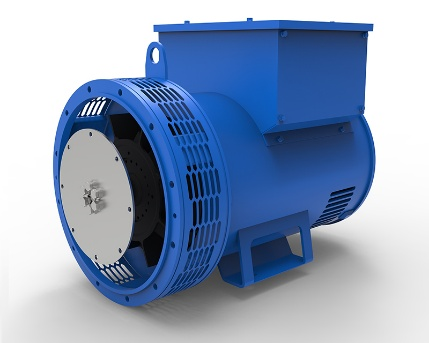
Sizing a 50Hz generator system for a factory is not simply about adding every machine’s nameplate power. Engineers need to establish steady-state demand, check the transient impact of large motors, assess nonlinear loads, allow for planned expansion, and apply site derating. EvoTec Power develops industrial synchronous alternators for industrial applications. The EVO188 series serves smaller-scale industrial power systems within EvoTec’ s product range.
Start With the Steady-State Load
Begin with a detailed load schedule. Record each load’s rated kW or kVA, power factor, duty cycle, and expected operating time. Do not assume every connected load operates at full output simultaneously. Apply realistic demand and diversity factors based on the process.
For a load with known kW and power factor, estimated kVA is kW ÷ power factor. Resistive loads such as heaters are generally close to unity power factor and mainly contribute real power. Inductive loads, including motors and transformers, consume both real and reactive power, so their kVA demand can be higher than their kW value.
For illustration, take a factory operating two concurrent load groups: 120 kW resistive heating loads and 160 kW motor loads at 0.8 power factor.
- Heating (resistive): 120 kW = 120 kVA
- Motor (active power converted to apparent power):
Total operating apparent-power demand (excluding extra miscellaneous loads and design margins):
This outcome is a calculated aggregate load requirement and should not be treated as the final alternator rating.
Check DOL Starting Impact
Large asynchronous motors can make a running load appear smaller than the source actually needs to handle. With direct-on-line (DOL) starting, an induction motor can draw more than six times its full-load current during acceleration. That inrush may cause a voltage dip and frequency disturbance when the source lacks sufficient short-term capability.
Identify the largest motor, its starting method, locked-rotor current or starting kVA, and the motor-starting sequence. First calculate normal running demand, then test the worst starting event. A pump may require modest power after reaching speed but impose much greater instantaneous demand during DOL starting.
Where soft starters or variable-frequency drives are permitted, compare their starting performance with DOL. Lower starting current can ease voltage dip, but VFDs also introduce nonlinear electrical behavior and require a harmonic assessment.
Plan for Future Expansion
Industrial plants often add production lines, pumps, compressors, HVAC equipment, or auxiliary systems after commissioning. For large projects, a planning margin of about 20–30% may be considered when future expansion is reasonably foreseeable. It should reflect the project roadmap rather than compensate for missing load data.
Separate current peak demand from forecast expansion load. This creates a transparent engineering basis and helps prevent both underpowered and unnecessarily oversized equipment. The objective is sufficient usable capacity, not the largest nameplate.
Assess Load Type and THD
Load composition affects power quality as well as capacity. Linear resistive loads generally do not generate significant harmonic current. Inductive motors are mainly a power-factor and starting concern, although distorted voltage can still affect their operation.
Nonlinear rectified loads are different. UPS systems, battery chargers, switched-mode power supplies, and many electronic drives draw current in pulses. These current waveforms create harmonic currents that can distort the electrical system. Fluke notes that nonlinear loads can produce harmonic distortion, overheating, and equipment malfunction when distortion becomes significant.
Therefore, total harmonic distortion (THD) should be part of the sizing review when a project contains substantial rectifier-based equipment. Engineers should evaluate the alternator against the actual nonlinear-load profile and consider appropriate harmonic mitigation, excitation arrangements, or system configuration where required. Cummins also notes that applications with significant nonlinear loads may require larger alternators or suitable excitation arrangements to manage harmonic effects.
Match Frequency and Alternator Rating
A 50 Hz project requires coordinated selection of the engine, alternator, controls, and connected equipment. EvoTec Power’s EVO188 series is specified for 25–54 kVA continuous output at 50 Hz, with 400/480 V options, 2/4/6/8/10 poles, Class H insulation, self-excitation, and an ETC-1 AVR. The product page also states that the series can be paired with a 45 kva generator. It is important to note that the alternator is the component converting mechanical energy into electricity and does not constitute a full generator package.
The EVO188 series uses a short-structure design intended to support ventilation and heat dissipation. Listed options include single-phase reconnectability, CT/PT, double bearings, space heaters, and auxiliary windings. These details matter to OEMs and project integrators when matching the alternator with the engine, enclosure, controls, and site conditions.
Apply Altitude and Temperature Derating
The rated capacity must be checked against actual site conditions. High altitude reduces air density, while extreme ambient temperature can reduce cooling capability. Manufacturer application guidance may therefore require derating under elevated altitude and temperature conditions. Caterpillar, for example, notes that some generator systems require derating above 1,000 m altitude and/or 40°C ambient temperature, depending on the application and equipment.
Apply the manufacturer-approved correction factors for the site’s maximum altitude and ambient temperature.
Take a practical example:
- Base alternator rating: 45 kVA
- Applied site correction factor: 10 % derating (example value only)
- Derated usable capacity: 45 kVA × 0.90 = 40.5 kVA
This 10 % derating serves purely for demonstration purposes. Real-world projects must adopt the genuine correction data provided for the selected power system.
Make the Final Selection
A reliable sizing process follows a clear sequence: calculate diversified steady-state kW and kVA, identify the worst DOL starting event, assess nonlinear-load and THD risks, add justified expansion capacity, and then apply altitude and temperature derating.
For applications whose corrected running and starting requirements remain within the verified envelope, a 45 kva generator solution may be suitable. For different project requirements, EvoTec Power offers a broader industrial alternator portfolio and customized alternator services based on power, voltage, and frequency requirements.
The goal is not to select the biggest rating available. It is to select an alternator with enough usable capacity after starting events, harmonic effects, future growth, altitude, and temperature are all taken into account. For OEMs, contractors, and industrial project teams, this calculation provides a defensible basis for equipment selection and helps the final 50hz generator system operate reliably in its intended environment.
