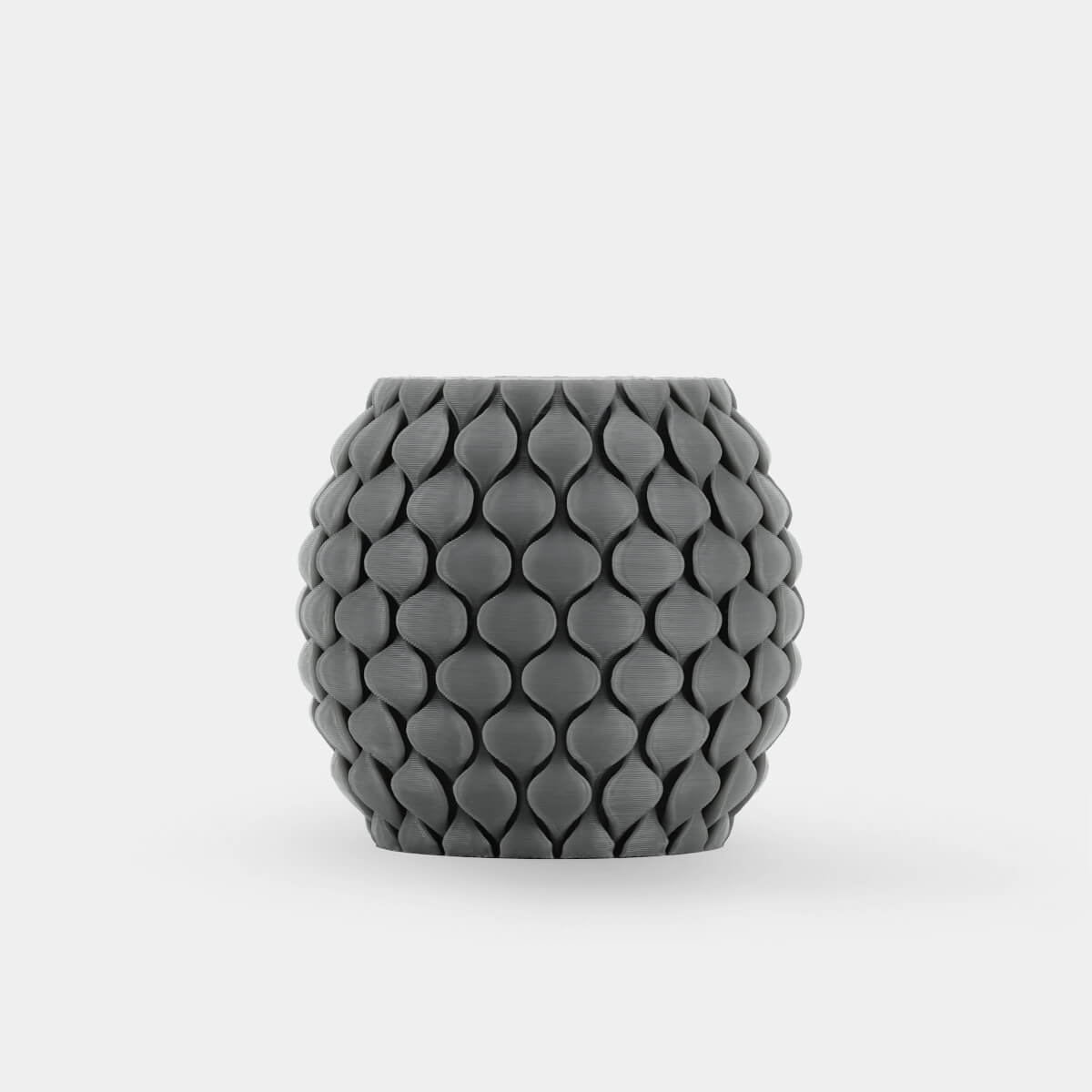
Choosing between standard PLA and PLA+ can affect print reliability, part durability, purchasing costs, and production consistency. For workshops, prototyping teams, educators, and small-scale manufacturers, the decision is less about finding one universally superior material and more about matching filament behavior to the job. Understanding the differences between 3D printer PLA filament helps buyers select material with clearer performance expectations.
What Is PLA and Why Is It Widely Used?
PLA, or polylactic acid, is widely used in FDM 3D printing because it is comparatively easy to process and generally offers low warping. That makes standard PLA practical for visual models, concept prototypes, fixtures, and routine printing where extreme impact resistance is not the primary requirement.
SUNLU describes its PLA as an entry-level material with good flowability and a low clogging risk. Its product data lists tensile strength of 40±6 MPa, flexural strength of 65±6 MPa, and notched Izod impact strength of 5±3 kJ/m². The recommended nozzle range is 200–210°C at 50–100 mm/s and 210–240°C at 100–200 mm/s, with a 50–60°C bed.
For procurement teams, consistent feeding is also important. SUNLU states that its filament is designed for broad compatibility with mainstream FDM printers. The product page lists a 1.75 mm diameter with a 1.75 ± 0.02 mm tolerance, while neat winding is intended to reduce tangling and feeding problems.
How Does PLA+ Differ From Standard PLA?
PLA+ is not simply a different name for ordinary PLA. The term generally refers to PLA formulations modified to improve selected performance characteristics, especially toughness. Because formulations vary by manufacturer, buyers should compare technical data rather than assume every PLA+ product has identical properties.
SUNLU PLA+ is described as reinforced and toughened PLA. Compared with the standard PLA data above, SUNLU’s PLA+ lists tensile strength of 46±5 MPa, flexural strength of 83±5 MPa, and notched Izod impact strength of 10±3 kJ/m². Its elongation at break is 10±2.5%, and its heat deflection temperature is listed at 56±5°C.
For users comparing 3D printer PLA filament with PLA plus filament, toughness is one of the most practical distinctions. A more impact-resistant formulation can be useful when printed parts may be handled frequently, experience minor impacts, or need to withstand everyday use without being as prone to brittle failure.
Printing Experience: Is PLA+ Harder to Use?
A common assumption is that improved toughness must require substantially more complicated printing. That is not necessarily the case with the SUNLU PLA+ formulation. SUNLU lists a nozzle range of 205–215°C at 50–100 mm/s and 215–245°C at 100–200 mm/s, with a 50–60°C bed.
The company also highlights high flowability and a low clogging risk for PLA+. Its winding process is designed to keep filament orderly and reduce tangling or knotting during feeding. For production environments, these characteristics matter because usable performance includes both mechanical properties and day-to-day print stability.
Which Material Fits Different Business Applications?
Standard PLA can make sense when the priority is efficient production of appearance models, early prototypes, educational parts, display pieces, or other components that do not face significant impact. It is also useful when teams want a straightforward material for iterative design work.
PLA+ becomes more relevant when durability and impact resistance receive greater weight. Functional prototypes, frequently handled models, brackets, covers, and other parts exposed to routine mechanical contact may benefit from its tougher formulation. However, the exact application should still be validated through testing because geometry, layer orientation, infill, print parameters, and load conditions affect final part performance.
PLA vs PLA+: How Should Buyers Decide?
The choice between 3D printer PLA filament and PLA plus filament should start with the application rather than the material label. Teams can consider four factors: required toughness, expected handling or impact, printing workflow, and material cost. If a part is primarily visual and easy processing is the main objective, standard PLA may be sufficient.
If repeated handling or accidental impacts are more likely, PLA+ can provide a useful performance margin. For buyers evaluating SUNLU materials, the company’s published technical data provides measurable points for comparison instead of relying only on the “PLA+” name.
SUNLU’s Role in PLA and PLA+
SUNLU provides both standard PLA and PLA+ options for FDM printing, allowing users to select a material according to the intended application. Its PLA emphasizes easy printing and low warping, while its PLA+ focuses on increased toughness and impact resistance. Both product lines are positioned around stable feeding and accessible printing workflows.
For business buyers, this distinction can simplify material selection across different projects. Standard PLA can cover routine modeling and prototyping, while PLA+ can be reserved for applications where additional toughness is more valuable. SUNLU’s published specifications also give purchasing and engineering teams concrete parameters to review before standardizing a filament.
Making the Material Choice More Practical
Neither PLA nor PLA+ is automatically the better choice for every project. Standard PLA remains a practical option for straightforward models and prototypes, while PLA+ offers a tougher formulation for applications where impact resistance and reduced breakage are more important. The right selection depends on part requirements, printer settings, production volume, and expected use.
For businesses comparing 3D printer PLA filament and PLA plus filament, technical data and application testing provide a more reliable basis for procurement than material names alone. SUNLU’s product range gives users both approaches, making it possible to align filament selection with the performance requirements of each printing task.
